
Incident, Problem and Change Management: Getting the Fundamentals Right in a Cloud World
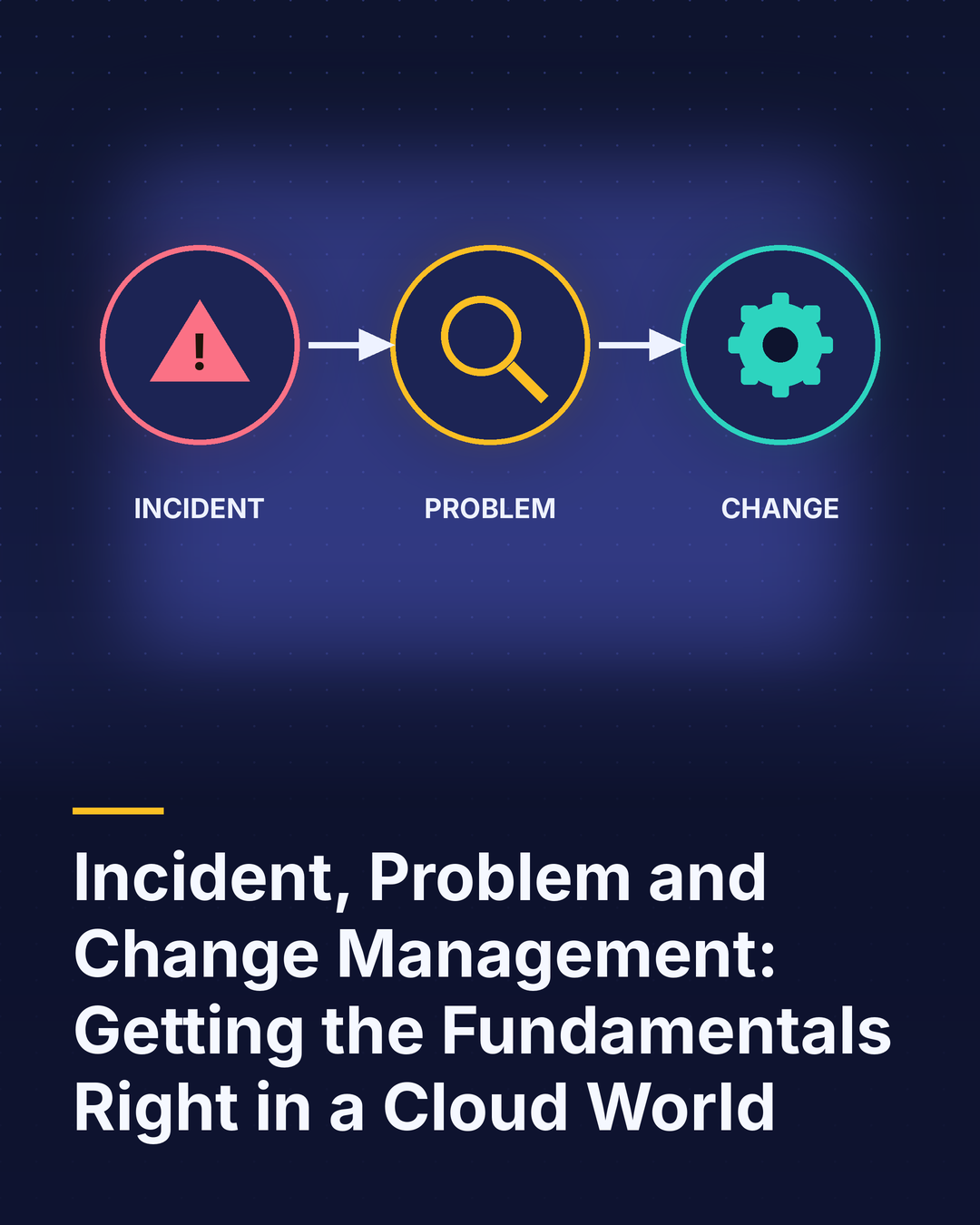
The move to cloud infrastructure, microservices and continuous delivery has changed the pace and shape of IT operations considerably. Some have concluded that traditional service management disciplines, particularly incident, problem and change management, belong to an earlier era. That conclusion is mistaken. These practices remain essential. What has changed is how they must be applied.
Incident Management: Restoring Service Quickly
The purpose of incident management is unchanged: restore normal service as quickly as possible and minimize business impact. In cloud environments, however, incidents often originate in automated monitoring rather than user reports, and a single underlying fault can generate hundreds of alerts across interconnected services.
Effective incident management in this context depends on several capabilities.
- Event correlation that groups related alerts into a single actionable incident
- Service mapping that shows which business services are affected, so that priority reflects business impact rather than technical severity alone
- Clear major incident procedures with defined roles, communication templates and stakeholder updates
- Collaboration tooling that brings the right engineers together quickly, wherever they are located
Problem Management: Eliminating Root Causes
Problem management is frequently the most neglected of the three disciplines, because the pressure of daily incidents leaves little time for investigation. Yet it offers the greatest long-term return. Each problem resolved at its root prevents a series of future incidents.
In a cloud world, problem management benefits from rich telemetry and the ability to analyze patterns across large volumes of incident data. Teams should hold structured post-incident reviews, focused on learning rather than blame, and track corrective actions to completion. Recurring incidents that share a common cause should be identified automatically and linked to a problem record.
Change Management: Enabling Speed Safely
Change management has attracted the most criticism, often justifiably, when it has relied on weekly advisory boards reviewing every change regardless of risk. In an environment where development teams deploy many times each day, such an approach is simply impractical.
Modern change management distinguishes between changes by risk. Standard changes, which are low-risk and well understood, can be pre-approved and deployed automatically through delivery pipelines. Normal changes receive proportionate review, increasingly informed by automated risk scoring based on historical success rates and affected services. Emergency changes follow an expedited path with retrospective review.
The objective is not to slow delivery but to ensure that the organization understands what changed, when and why, which is essential information when an incident occurs.
Connecting the Three Disciplines
The greatest value emerges when incident, problem and change records are connected on a common platform. An incident can be linked to a recent change, revealing the likely cause immediately. A problem can generate a change to implement a permanent fix. Historical data on which changes cause incidents can refine risk scoring over time.
The Bottom Line
Incident, problem and change management remain the foundation of reliable IT operations, even in highly automated cloud environments. Applied with modern tooling, risk-based thinking and integration with delivery pipelines, they support speed rather than impede it. Organizations that abandon these disciplines in pursuit of agility often find that reliability suffers and trust erodes. Those that modernize them, by contrast, achieve both rapid delivery and the stability that the business depends upon.